

Mandated Oregon interim testing just added another heaping scoop to the loaded plates early literacy leaders were already struggling to carry, but rolling out interim assessments for all kids in grades K-8 three times a year is more than just another compliance task.
It could provide the key evidence district and school leaders need to close reading skills gaps in their elementary schools.
Under SB 141, every Oregon district must now review those interim results in a public board meeting three times a year. This means K-2 leaders will have public evidence about their youngest readers on hand and available to use at the moments when staffing and intervention decisions get made, perhaps for the first time.
The public piece of this is bound to feel more than a little scary. Nobody wants to stand up in the fall and explain why so many 1st graders are behind. But solid data in front of your board and your community is what proves the need for early support is real. It’s the evidence you need to drive change.
The research shows exactly how urgent that need is. Researchers at Johns Hopkins University’s Center for Research and Reform in Education found that 88 percent of students who aren’t reading at benchmark at the end of 1st grade are still behind a full school year later. Just 1 in 8 catch up.
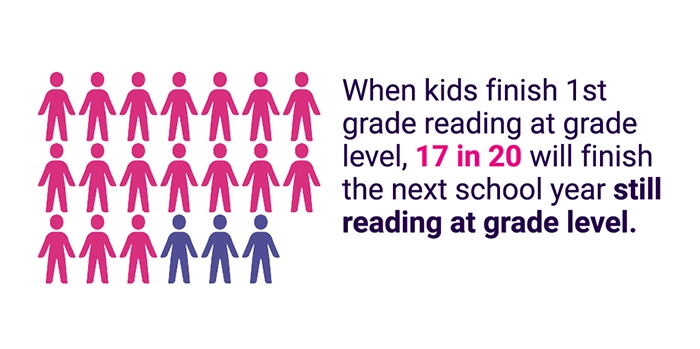
The flip side is just as striking. In the same study, 17 in 20 students who finished 1st grade at benchmark were still on track at the end of 2nd grade, without any additional tutoring. “It really highlights that 1st grade is a window, a narrow window where we’re working on building decoding skills and word reading foundations,” says lead researcher Amanda Neitzel, PhD.
That window closes long before 3rd grade state test results arrive.
Interim literacy assessment results can show the urgency early while gaps can still be fixed. Leaders who plan for that will walk into board meetings with a case, not a confession. Here’s how to get there.
Use interim assessment results to build your case for K-2 intervention budgets
For many districts, 3rd grade state scores have been the first reading results to get real board attention. By then, asking for K-2 resources has meant explaining a problem after the fact.
Interim testing changes the timing. Boards will now see fall results that show where your kindergarten and 1st grade readers stand and winter results that show whether your response is working. Here’s how to turn those results into a budget case.
Lead with the count, not the percentage.
“Thirty-eight percent of our 1st graders are below benchmark” is a statistic. “142 of our 1st graders are below benchmark, and our intervention staff can serve 60 of them” is a decision the board has to make. Pairing every K-2 result with the number of students it represents and the number your current staffing can reach connects the dots to guide them in making it.
Connect this year’s kindergartners to your 3rd grade target.
Oregon’s goal is 52.6 percent of 3rd graders reading proficiently by 2029-30. This year’s kindergartners are the 3rd graders who will be tested that spring. When you show the board where they stand now, you’re showing them the class that will determine whether your district hits its target.
Show the cost of waiting.
Only about 1 in 8 students who finish 1st grade below benchmark catch up the following year. Those who don’t are more likely to need more intensive support later, in grades where phonics instruction has mostly disappeared from the curriculum. Intervention in K-1 isn’t an extra expense. It’s one that ultimately reduces the number of students who need costlier help later on.
“Investing early is the most important thing and making sure that your kids get off to a great start before before they start to have that feeling of ‘I’m not getting it,'” says Julie Richards, director of elementary curriculum and instruction in Bend-LaPine Public Schools.
Use winter growth to show what’s working.
If students in intervention grew faster between fall and winter than similar students who weren’t served, that’s your evidence for expanding. If they didn’t, that’s your evidence for changing course before spending more. Either way, the board sees decisions driven by data.
Use ODE’s guardrails to protect good decisions
Interim tests should not take the place of progress monitoring or diagnostic assessments. A low score will tell you a kindergartner is behind. It won’t tell you whether the gap is phonemic awareness, letter-sound knowledge, or something else. That gives you backing to keep your dyslexia screener, progress monitoring, and teacher judgment at the center of decisions about who gets intervention.
Plan ahead so your board reviews tell the whole story
ODE recommends each board review including the following:
- Student assessment participation
- Results by grade and results by student group
- Growth across testing windows
- Key observations and action steps
That structure works in your favor. Before your first board review, decide which K-2 patterns you want the board to see and what you’ll ask for because of them.
When you arrive with both data and a plan for responding to it, you show you’re setting the agenda, not defending a number.
ODE also advises public review must not be used to judge or compare individual teachers, which should help you keep the conversation on the system rather than on a classroom.
Count on a more complete picture with interim testing than your state scores
District leaders have long struggled with Oregon’s family opt-out laws that limit participation in state summative tests in reading. Participation across grades and most student groups remains below the 95% federal requirement.
Because interim testing isn’t summative, those opt-out laws don’t apply.
This means your interim data will likely cover more of your students than your state scores do. When you tell your board how many K-2 students need help, that number will be harder to dismiss.
Show progress before the state test does
Much has been said about the state’s new district performance targets for measures like 3rd grade reading and the coaching from ODE that is expected for districts that fall short.
Interim testing could help here too. While state summative assessments are administered just once a year, interim assessments are designed to measure growth within a year, and for some districts, that growth will count toward their accountability targets.
Districts that choose academic growth as their local accountability metric will be measured on reading and math interim results. ODE also plans to weigh within-year interim growth when deciding whether a district can exit its coaching program.
If your literacy strategy is working, interim results will help you show it months before the next state test.
For Early Literacy Success School District grantees, common interim tests can help meet the grant’s student growth assessment requirement.

Turn the results into a plan
An interim test tells your board where K-2 readers stand three times a year. What happens between those windows decides whether the next results look any different.
When fall results show a group of 1st graders behind, the questions shift fast. Who works with those students, and how often? How will you know week to week whether it’s working, instead of waiting for winter testing to find out? ODE’s guidance points toward screening and progress monitoring for those answers, along with intervention that tracks its own growth.
End your board reports with a specific ask
ODE’s board report format closes with key observations and action steps, so make yours concrete. Say how many more students you want to serve, how often, starting when, and what funding covers it. If your district has an Early Literacy Success grant, high-dosage tutoring like the 1:1 daily intervention from Ignite Reading is an allowable use, so name it.
Put together, it might sound like this:
“Our fall results show 142 1st graders below benchmark. Research tells us only about 1 in 8 students who finish 1st grade behind will catch up the following year. Our current team can reach 60 of them. We’re asking to expand tutoring to the remaining 82 before spring testing, using our Early Literacy grant funds.”

Early support drives outcomes in Bend
Julie Richards, director of elementary curriculum and instruction in Bend-LaPine Public Schools, recalls watching her district’s readers “starting to fall behind about the middle of 1st grade and then never catching up.” The district turned to 1:1 early literacy intervention through high-dosage tutoring from Ignite Reading to turn the trajectory around.
“Ignite Reading gives us that one-on-one time with as many kids as we can,” Richards says. ” We have a lot of absent staff and our students often don’t get intervention, so this is a great way for us to be able to provide support every day.”
Frequently asked questions about Oregon interim testing
What is an interim assessment?
An interim assessment is a benchmark test given at set points during the school year, usually fall, winter, and spring. Oregon’s Interim Test Implementation Guide describes interim tests as periodic, standardized checks on student progress toward grade-level standards. They sit between daily formative assessment in the classroom and the end-of-year summative test, giving schools a read on progress while there’s still time to adjust instruction.
What’s required for interim testing in 2026-27?
Every district and public charter school must give an interim test in language arts and math three times a year in grades K-8. ODE suggests testing 3 to 6 weeks after the start of school, after winter break, and after spring break.
Results must be reviewed at least three times a year with each school’s administrators and in a public meeting with the superintendent and school board.
Districts switching from an interim test that isn’t on the approved list can keep using their current test in 2026-27. The approved test must be in place by August 30, 2027.
| Approved Interim Test | Vendor | Grades |
|---|---|---|
| i-Ready Diagnostic (Inform) | Curriculum Associates | K-12 |
| MAP Growth | Houghton Mifflin Harcourt | K-12 |
| Star | Renaissance | K-12 |
| Smarter Balanced interims | Cambium | 3-12 |
Does the interim test replace our dyslexia screener?
No. Oregon’s requirement to universally screen kindergartners for risk factors of dyslexia hasn’t changed. The screener looks at specific early reading skills like phonological awareness, letter-sound knowledge, and rapid naming. The interim test measures progress toward grade-level standards. Star CBM Reading, MAP Reading Fluency, and i-Ready Inform with Literacy Tasks appear on both approved lists, though districts still must give the screener subtests Oregon rules require.
Can we still use DIBELS?
DIBELS remains an approved screener for dyslexia screening, but it’s not on the approved list of four assessments that are approved by the state as interim tests.
What about students who take the Oregon Extended Assessment?
ODE suggests accessibility supports on interim tests mirror the supports in a student’s IEP or 504 plan and accommodations be added on for students whose academic expectations are significantly modified.
How do interim tests fit with Oregon state testing?
They sit alongside it.
The OSAS statewide summative tests are still required in grades 3-8 and high school, and the spring summative test does not count as one of the three interim administrations. Interim scores aren’t directly comparable to state results, and a student can score higher on interims than on the state test.
What about OSAS interim assessments?
Oregon has offered Smarter Balanced interim assessments for years through the OSAS Portal, and they’re now one of the four approved options. Districts can meet the requirement in grades 3-8 with the Smarter Balanced Interim Comprehensive Assessments, Interim Assessment Blocks, or Focused Interim Assessment Blocks. Different assessments are required for the K-2 band.
Is this a through-year assessment?
No. Some states use a through-year model in which the end-of-year state test is split into parts given across the year that add up to one summative score. Oregon’s interim tests are separate from OSAS, don’t produce a state score, and don’t replace the summative test.