
If you’re turning to the book shelves in hopes of deepening your understanding of Science of Reading instruction, you’re not alone. As more and more districts make the shift to evidence-aligned literacy instruction, more educators than ever are searching for research-backed reading that will translate the complex literacy science into
We asked veteran literacy coaches, reading specialists, and instructional leaders on our team: Which Science of Reading books actually changed your practice?
Here are the ones that made it onto their shelves.
Best Structured Literacy Books for Educators
Structured literacy is the instructional framework at the heart of Science of Reading implementation. It’s explicit, systematic, and grounded in decades of research about how the brain learns to read.
Whether you’re new to structured literacy or looking to refine your practice, these books break down what students actually need and how to deliver it effectively.
The Most Accessible Introduction to Science of Reading
If you’re in the early stages of your Science of Reading exploration, you need a book that will open the door and take you on a journey deep into structured literacy territory.
Look no further than Anna Geiger’s Reach All Readers: Using the Science of Reading to Transform Your Literacy Instruction which breaks down complex concepts in approachable language.
As a former teacher turned literacy advocate, Geiger knows firsthand what it’s like to shift instructional practices. Her background teaching in a high-poverty Title I school informs every page of this book, making it feel less like academic theory and more like guidance from a colleague who’s been in the trenches.
Ignite Reading Literacy Specialist Jody Roy describes Reach All Readers as essential for anyone new to Science of Reading: “It breaks down concepts we talk about all the time — like the Simple View of Reading and Scarborough’s Reading Rope — in a way that truly clicks.
“Along the way, it clearly illustrates the five components of reading and supports them with research, classroom-ready resources, and actionable strategies you can use right away,” — Jody Roy, literacy specialist, Ignite Reading

More From Anna Geiger
- Beyond the book, Geiger continues to support educators through The Triple R Teaching podcast, where she interviews leading experts on the Science of Reading.
- Her website, The Measured Mom, offers free printables and resources for elementary teachers implementing structured literacy practices.
Understanding the Reading Brain
Dr. Maryanne Wolf’s Proust and the Squid: The Story and Science of the Reading Brain offers crucial context for why explicit, systematic instruction matters.
Wolf, director of the UCLA Center for Dyslexia, Diverse Learners, and Social Justice, is a cognitive neuroscientist who has spent decades studying how the brain learns to read. Her research has played an important role in understanding the distinct differences between learning to speak the English language and read it.
Unlike spoken language, the human brain wasn’t wired to read. Instead, we repurpose neural circuits originally designed for other functions — creating new pathways that connect visual processing, language comprehension, and meaning-making. This explains why some students need explicit, systematic instruction to build those pathways successfully.
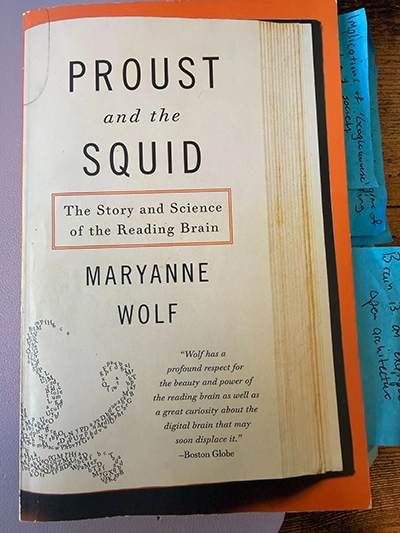
Alex Pynes, literacy success partner at Ignite Reading, describes how the book shifted his entire understanding of literacy instruction: “When I first read this book, I didn’t know anything about the Science of Reading. The author does a great job of explaining concepts in an accessible way.”
Particularly resonant for Pynes was Wolf’s description of the “open architecture” of the human brain and the process by which it can be rewired as a student learns how to read.
“Another concept is just how unnatural and new to human history reading is,” Pynes adds. “It is remarkable that we are able to do it at all and [the book] explains why it is necessary to teach reading in a structured, systematic way. Also, we learned to read and write more gradually throughout human history. It wasn’t just some dude in a room who figured it out.”
Understanding how the brain learns to read helps teachers make informed instructional decisions and advocate for evidence-based practices with colleagues, administrators, and families. Wolf’s work also extends to her research on digital reading and how screen-based reading affects comprehension — increasingly relevant as schools integrate more technology into literacy instruction.
Best Science of Reading Books for Improving Literacy Instruction
Phonics instruction is non-negotiable for teaching students to decode, but not all phonics instruction looks the same. These books help teachers understand not just what to teach, but how to teach it in ways that stick—addressing common instructional gaps that leave students guessing at words instead of reading them accurately.
Understanding How Reading Development Really Works
Know Better, Do Better: Teaching the Foundations So Every Child Can Read by David Liben and Meredith Liben helps educators understand the interconnected strands of reading development.
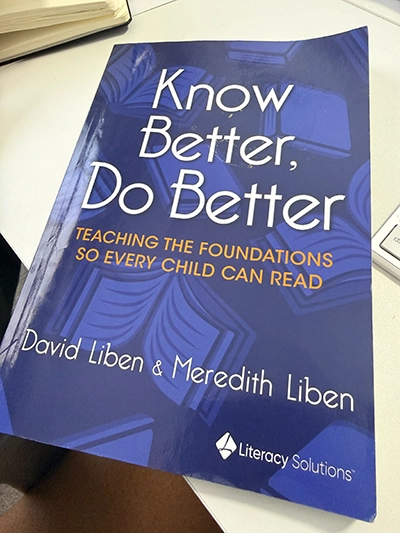
The Libens are longtime literacy educators who have worked extensively on curriculum design, teacher professional development, and literacy policy.
David Liben served as senior content specialist in English Language Arts for non-profit Student Achievement Partners and was deeply involved in developing Common Core State Standards. Meredith has spent more than three decades in education, teaching every grade from kindergarten through grad school, and currently serves as a senior fellow for strategic initiatives at Student Achievement Partners.
Erin Johnson, Ignite Reading’s lead director of student support, describes the book’s impact: “This book helped me early in my journey understand each strand of the word recognition rope more deeply. Through this, I had a deep understanding of how each strand is connected.”
The book’s power lies in how it illustrates the relationships between phonological awareness, phonics, and fluency—helping teachers see how instruction in one area supports growth in others. The Libens use Scarborough’s Reading Rope as an organizing framework, showing how skilled reading requires multiple strands woven together.
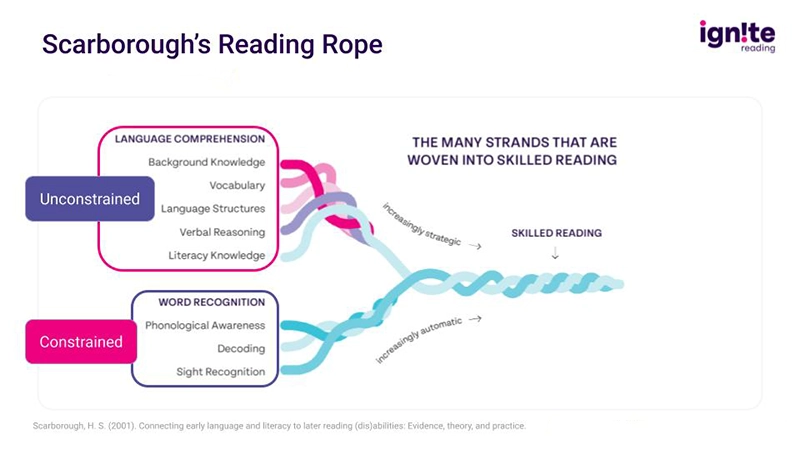
For educators who’ve been told “kids need phonics” without understanding the bigger picture, this book provides essential context about where phonics fits in the reading development continuum.
When You Need Classroom-Ready Strategies
Wiley Blevins’ Meaningful Phonics and Word Study: Lesson Fix Ups for Impactful Teaching bridges the gap between research and real classroom application. Blevins brings more than 30 years of experience as a literacy educator, author, and consultant. He’s written more than 40 books on literacy instruction and worked with districts across the country implementing structured literacy approaches.
Emily White, a senior literacy success partner on the Ignite Reading team, explains why this book resonated: “Wiley Blevins doesn’t just describe literacy concepts — he gives clear, actionable strategies that honor the Science of Reading while fitting into the real flow of instruction. Just check out his letter to teachers on the very first page of the book, and tell me that you don’t want to dive in!”
What sets Blevins apart is his focus on the lesson-level decisions teachers make every day. He addresses the practical questions that keep teachers up at night.
- How much time should I spend on phonics?
- When do I move on to the next skill?
- What do I do when students aren’t transferring their phonics knowledge to connected text?
His “fix ups” are exactly what the title promises — specific adjustments that make phonics instruction more effective without requiring a complete curriculum overhaul.
More From Wiley Blevins
Beyond this book, Blevins has authored the popular phonics program A Fresh Look at Phonics and regularly presents at literacy conferences nationwide. Blevins’ blog and articles provide ongoing support for teachers implementing his strategies.
Science of Reading Books for Assessment and Intervention
When Students Aren’t Making Progress
David Kilpatrick’s Essentials of Assessing, Preventing, and Overcoming Reading Difficulties is the go-to resource for understanding why some students struggle despite instruction.
“There are a LOT of nuggets in this book,” says Julia Weber, senior manager of academic innovation. “[It] helped me understand why some kids can map chunks without meaning — adding nuance to what I knew about orthographic mapping — why and how assessments miss critical gaps, and what makes struggling readers accelerate.”
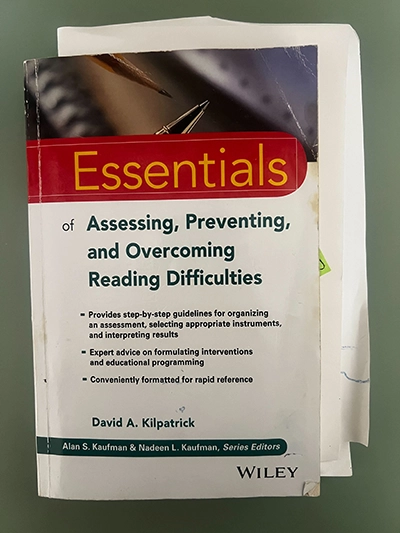
What makes Kilpatrick’s work transformative is his focus on orthographic mapping — the process by which students form permanent representations of words in memory. While many educators have heard about orthographic mapping, they may not fully understand how to assess whether it’s happening or how to intervene when it’s not. Kilpatrick provides both diagnostic tools and remediation strategies to close those gaps.
The book includes detailed assessment protocols that help educators pinpoint exactly where reading is breaking down: Is it phonological awareness? Phonics knowledge? Fluency? Kilpatrick teaches educators to distinguish between different types of reading difficulties so interventions can be precisely targeted.
More From David Kilpatrick
Kilpatrick is also the author of Equipped for Reading Success, which focuses specifically on developing phonological awareness.
Best Science of Reading Books for Multilingual Learners
Teaching students who are simultaneously developing English language proficiency and foundational reading skills requires specialized knowledge. Too many educators have been told they must wait until students have “enough English” before teaching phonics — a myth that delays critical literacy instruction.
Connecting Language Development and Literacy Instruction
Literacy Foundations for English Learners: A Comprehensive Guide to Evidence-Based Instruction by Dr. Elsa Cárdenas-Hagan addresses a critical question: How do we teach foundational reading skills while students are still developing English language proficiency?

Dr. Cárdenas-Hagan is a bilingual speech-language pathologist and internationally recognized expert in literacy instruction for multilingual learners. Founder of the Bilingual Special Education program at The University of Texas Health Science Center at Houston, she’s has trained thousands of educators in structured literacy approaches for English learners. Her work centers on the reality that multilingual learners benefit from the same explicit, systematic instruction in foundational skills that all students need —with thoughtful adaptations that honor their linguistic assets.
Chantal Ross, senior literacy success partner at Ignite Reading, says she turned to Cárdenas-Hagan’s book as a multilingual learner teacher, struggling to connect the dots of language and literacy instruction.
“I was convinced that language and foundational literacy development could be addressed simultaneously in the classroom and it was not necessary to delay instruction in foundational reading skills until students developed sufficient English language skills,” she recalls. “I heard so much of this type of discussion in the ELD field, but I couldn’t accept that thinking.”
The book provides specific guidance on building phonological awareness in students whose home language may have different sound structures than English, teaching phonics patterns that don’t exist in students’ first languages, and integrating vocabulary and comprehension instruction with foundational skills. Cárdenas-Hagan draws on both research and her extensive clinical experience to show what this instruction looks like in practice.
Ross says Cárdenas-Hagan “actually walked the walk of what I had been imagining possible for MLL language and literacy instruction.”
“Her trainings and articles validated my hunches and helped me connect the dots. Then she wrote a book that made the picture come in to focus even more!” — Chantal Ross
More From Dr. Elsa Cárdenas-Hagan
Beyond the book, Dr. Cárdenas-Hagan offers professional development through her organization, Valley Speech Language and Learning Center, and has published numerous articles on bilingual literacy development.
Why Science of Reading Books Matter for Early Intervention
The Research Case for Early Literacy Support
The Early Years Matter: Education, Care, and the Well-Being of Children, Birth to 8 by Marilou Hyson and Heather Biggar Tomlinson provides the research foundation for why early literacy intervention is critical. Hyson is senior consultant with the National Association for the Education of Young Children (NAEYC) and former editor of Early Childhood Research Quarterly. Tomlinson is a faculty member at Erikson Institute’s graduate school in child development.
“The authors synthesize current research to demonstrate how high-quality early care and education during these foundational years yields significant benefits for children, families, and society —both immediately and across the lifespan,” says Jennifer Schmidt, director of instructional design at Ignite Reading.
While not exclusively focused on reading, the book makes a compelling case for why the birth-to-8 continuum is critical for all developmental domains — including literacy. The research they present shows that early intervention is not just helpful but essential, and that waiting for students to “catch up” on their own rarely succeeds.
For educators advocating for resources to support 1st and 2nd graders learning to read, this suggestion provides the evidence base to make a compelling case.
The book bridges early childhood education and elementary literacy, helping educators see how oral language development, pre-literacy skills, and formal reading instruction connect across the years before 3rd grade. For districts considering where to allocate intervention resources, the research Hyson and Tomlinson present makes clear that prevention in the early years is far more effective than remediation later.
Choosing Your Next Science of Reading Book
At the end of the day, the best Science of Reading book for you depends on where you are in your literacy instruction journey.
New to structured literacy? Start with Anna Geiger’s Reach All Readers for a comprehensive overview. If you’re troubleshooting why students aren’t progressing, David Kilpatrick’s assessment guide offers deeper diagnostic understanding. Educators working with multilingual learners will find practical strategies in Dr. Cárdenas-Hagan’s work, and if you’re curious about the neuroscience behind reading development, you will appreciate Maryanne Wolf’s research.
What all these books have in common: They honor both the science and the art of teaching reading. They translate research into classroom-ready strategies that help students become confident, fluent readers.