
There are few numbers that weigh on a superintendent more heavily than school attendance data.
I’ve sat in countless district meetings staring at spreadsheets that told a painful story: too many children missing too much school, too few attendance interventions producing lasting change, and not enough people or resources to move the needle.
National data show that millions more students are now chronically absent than before 2020. In nearly half the nation’s urban school districts, more than 30 percent of students were absent for 10 percent or more of the 2024-25 school year.
What worries me most is not simply the scale of the problem, it’s what the data represent.
When students miss school consistently, especially in the early grades, what we’re often seeing is something deeper: disconnection, discouragement, or the nagging feeling school is a place where they struggle more than they succeed.
That is especially true for young readers.
Children know when they are behind. They know when reading feels harder for them than it does for their classmates. And when school becomes a daily reminder of what feels difficult, avoidance can become a rational response.
Reading is one of the first places children begin forming beliefs about themselves as learners. When students experience success early, they are more likely to participate confidently, engage more deeply, and see school as a place where they belong. When they struggle early and repeatedly, the opposite can happen.
District leaders have long understood that absenteeism compounds over time. What we may be seeing now is the possibility that the reverse is also true: when schools intervene early enough to help students experience meaningful success, they may also strengthen a child’s long-term connection to school itself.
That’s why an unexpected pattern we’ve been seeing in districts across the country deserves much more attention.
The intervention making an impact isn’t one built around attendance at all but one designed to close early literacy gaps.
Attempting school attendance interventions
Most district leaders I know have spent years trying to solve chronic absenteeism from every possible angle. We certainly did when I was superintendent with Tulsa Public Schools.
We hosted phonebanks to call families to learn about their needs and offer support.
We launched awareness campaigns to blanket the communities we served with information and resources to help families get students to school every day on time.
We built attendance teams that met daily to review the data, identify the trends, and target support in real time.
We worked with community sponsors to offer incentives and celebrate progress.
We went door to door, canvassing our communities to find those students who did not return after the pandemic.
Sometimes those efforts helped at the margins, and for many students they made a real difference. But too often, the gains didn’t last. Because the truth is, attendance is rarely just an attendance problem.
Behind chronic absenteeism numbers: why students stay home
In recent years, chronic absenteeism numbers have represented much more than missed school days.
They have represented children whose lives and routines have been shaped by disruption and instability during some of their most formative years. And they reflect families navigating housing instability, transportation barriers, health concerns, economic stress, growing mental health needs, and other pressures that can make consistent attendance difficult.

The absensce of recovery
While districts have made major strides in learning recovery in the wake of the pandemic, student absences continue to stymie district leaders across the board.
How much of an impact has chronic absenteeism had on recovery? Harvard and Stanford researchers crunched the numbers in 2026 for an answer published in the 2026 Education Scorecard. “If student absences had returned to pre-pandemic levels, the recovery would have been meaningfully larger (.03 to .05 grade equivalents) for districts at all income levels,” the report says.
They have also reflected schools working urgently to strengthen routines, supports, relationships, and habits that have frayed over time.
In the early grades, absenteeism is often driven largely by adult circumstances and logistics. Over time, something more complicated can begin to happen.
Children start forming their own beliefs about school and about themselves within it.
When students struggle academically, school can become a place associated with frustration, embarrassment, anxiety, and even failure. Absenteeism can then become about more than whether a family can get a child to school and more about whether the child wants to be there.
Those of us who have taught and served in schools, recognize something important: children are more likely to show up where they feel known, where they believe they matter, and where they feel successful.
How early literacy intervention changes attendance
Traditional attendance interventions matter. Schools should absolutely continue removing barriers, supporting families, strengthening communication, and helping students get to school consistently.
But most attendance strategies work largely from the outside in. They can help address obstacles and demonstrate care, but they cannot fully create the internal sense of connection, confidence, and success that helps a child feel excited to come to school each day.
That may be why something different appears to happen when the students who are struggling with reading begin experiencing sustained academic success through individualized support.
Students who are enrolled in daily one-to-one literacy tutoring are not only making strong reading gains. In many cases, educators are noticing that those same students are also showing up to school more consistently.
For some children, the experience of working one-to-one with a caring adult each day can begin to change what school feels like. Progress is visible. Success is celebrated in real time. The student is not being compared publicly to classmates or asked to hide confusion in a crowded classroom. Instead, they are building confidence, relationships, and a growing sense that school may actually be a place where they can succeed.
The intervention is not about pushing students toward school from the outside. It may be creating a pull from the inside.
None of this proves that tutoring alone can solve absenteeism, and we should be careful not to claim more than the research currently shows. But the pattern is hard to ignore, and the data is also promising.
In Johns Hopkins University’s second-year evaluation of a one-to-one early literacy intervention, researchers studied nearly 1,600 first grade students across 13 districts over a 36-week school year. Students attended an average of 85 percent of their virtual tutoring sessions, receiving roughly 33 hours of individualized literacy instruction from certified instructors.
Students participating in the program also significantly outperformed matched peers in reading skills gains, comparable to the impact of large-scale in-person tutoring programs nationally.
That level of sustained engagement matters. Anyone who has led a district knows how difficult it can be to maintain consistent participation across multiple schools and communities over time.
What may matter even more is what educators are noticing around that data.
“I need to be in school”
One of those educators is Jose Escribano, assistant superintendent and chief of family and community engagement for Springfield Public Schools, one of Massachusetts’ largest urban districts. Springfield partnered with Ignite Reading, the early literacy intervention studied by the Johns Hopkins University researchers mentioned above, to deliver daily one-to-one intervention for students who were reading below benchmark. Since then, he’s seen a notable impact on attendance among students in the program.
“One of the things that I’ve seen — not only that we’re getting all these great results — but the kids are literally crying at the end of the year because they’ve developed this mentorship,” Escribano says. “They’re going home and talking to their parents about this tutor, this Ignite Reading tutor, this mentor.”
The result is a bridge between home and the school, Escribano says, as parents see that their child is invested and that they have a mentor who is invested in them.
“Kids are like, I need to be in school. I can’t miss school because I need to meet with my tutor,” he adds.
Those are the kinds of comments we pay attention to as educators because they suggest something deeper happening. The motivation is not coming from an incentive program or a prize. It is coming from relationship, connection, and the feeling that someone at school truly knows and believes in them.
In California’s San Mateo County, Katharine Sullivan, executive director of The Big Lift, a county-wide collaborative focused on reading proficiency by 3rd grade, described seeing something unexpected during just the second month of implementation.
Students enrolled in the Ignite Reading program began attending school at significantly higher rates than they had earlier in the year, Sullivan says. Families noticed how excited their children were to connect with their tutor each day, she added, which earned their buy-in.
“I think that was a big surprise for everyone to really recognize kind of that individualized attention that each student is getting and how valuable that is,” Sullivan notes.
In Westfield, Massachusetts, school district Director of Curriculum and Instruction Susan Dargie put it even more simply:
“They wanted to be in school every day and on time to class to get online with their tutor.”
That is what one-to-one intervention does when it is done well. It doesn’t push students toward school from the outside. It creates a pull from the inside, and the academic results suggest that the impact has real staying power.
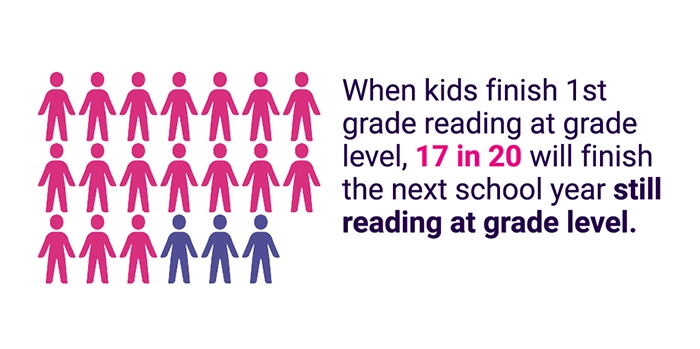
Among students in the Johns Hopkins evaluation who completed 1st grade reading on benchmark, 17 in 20 remained on grade level in 2nd grade, even without continued intervention. By contrast, students who did not reach benchmarks by the end of 1st grade rarely caught up without additional support.
That matters because students who can read can access everything else school has to offer. They can participate more fully, build confidence more quickly, and engage more deeply.
Reading success may not only improve academic outcomes. For some students, it may help transform school from a place of frustration into a place where they want to be.
The compounding impact of falling behind
We’ve long known that the students who miss school at high rates show lower academic achievement, decreased engagement, and fewer social connections. In kindergarten alone, chronic absenteeism has been linked to declines in both reading and math achievement, as well as reduced engagement.
Those impacts compound as students get older. Students who aren’t reading proficiently by the end of 3rd grade are four times more likely to drop out or fail to graduate on time than their peers who are reading proficiently.
By 6th grade, the trajectory is often already becoming visible: chronic absences, failing math or English, and behavioral struggles in 6th grade already identify 60 percent of students who will ultimately not graduate.
When a 1st grader begins showing up each day because reading is starting to make sense and because someone at school truly knows and believes in them, the trajectory may begin to shift in the other direction.

A reason to show up
Liz Cohen, author of The Future of Tutoring and Vice President of Policy at 50CAN, spent two years visiting schools across the country studying what separates tutoring programs that last from those that stall. What she found goes beyond curriculum and scheduling: tutoring gives students “the opportunity to demonstrate competence with a trusted adult.”
That relationship extends into every corner of the school day and can dictate whether students show up at all. A study conducted by Stanford researchers in 2024 found students who received high-dosage tutoring were more likely to attend school on the days their sessions were scheduled than peers who weren’t.
Changing trajectories, changing attendance
When a struggling 1st grader spends 15 minutes each day with a caring adult who knows exactly where they are academically, celebrates every breakthrough, and helps them experience success, something begins to change for that child.
A child who once associated school with frustration may begin to associate it with progress.
A child who felt invisible may begin to feel seen.
A child who avoided school may begin to feel pulled toward it.
As a superintendent, my team and I spent years studying attendance data and working hard to increase engagement in school. We were focused on getting children to school so that they were more academically successful, an important and necessary focus.
“Kids are like, I need to be in school. I can’t miss school because I need to meet with my tutor.”
— Ass’t Sup’t Jose Escribano

What I understood less clearly at the time was just how powerfully the relationship could work in the other direction. When students begin experiencing success in school, especially early, they are likely to become more motivated to attend consistently, creating a reinforcing cycle of attendance, learning, confidence, and connection.
As district leaders, we need to make sure we don’t wait for perfect research to begin asking better questions. If our district is investing in literacy interventions, are we also tracking attendance patterns for participating students?
Are we asking students why they show up?
Are we listening to what educators and families are noticing?
Because in this time of persistent absenteeism, one of the most powerful attendance strategies may not be an attendance campaign or an incentive program at all. It may be helping a child experience school as a place where they feel successful, connected, and genuinely want to be.