
The story’s the same at the end of every school year: District leaders sit down to evaluate their 1st grade ELA programs, and the results aren’t what they’d hoped for.
Enough years have passed that it can’t be the pandemic. Is it the teachers? The curriculum?
The answer, more often than not, is neither. These districts have both an evidence-based reading curriculum and caring, experienced teachers who’ve been trained in the Science of Reading. What’s missing is a system that catches the students falling behind before the end-of-year data confirms what everyone already suspected.
Here’s what the research says is actually happening in your 1st grade ELA program, and the questions district leaders should be asking before next school year begins.
Why tier 1 won’t close the reading gap alone
A strong 1st grade ELA program gets some students to benchmark. The research is clear on that.
What’s also clear is that the 1st graders who don’t master the skills necessary to reach grade level benchmarks by the end of the school year face an uphill battle to catch up.
88% of students not at benchmark at the end of 1st grade are still behind a full year later
Source: Center for Research and Reform in Education, The Johns Hopkins University; 2026

That number doesn’t represent a teacher failure. It highlights the system design problem that plagues early literacy instruction.
Researchers estimate some 60 percent of students need more than Tier 1 early literacy instruction in order to master foundational reading skills. In a classroom of 25 students, that 60 percent equates to 15 children who need more than universal instruction to achieve grade-level mastery.
A single classroom teacher delivering Tier 1 instruction to 25 students simply cannot provide the individualized repetition, real-time error correction, and targeted practice that some students need to keep pace.
That’s not a failure of the teacher. It’s a structural limitation of the classroom.
The students who need more won’t get there through Tier 1 alone. They need Tier 2 now, while the window is still open.
The districts that get this right don’t treat Tier 1 and Tier 2 as sequential steps in a process. Instead, they run in parallel, ensuring identification happens early and intervention begins before failure.
The skills your 1st grade ELA program must deliver for all students
First grade foundational reading skills instruction picks up right where kindergarten left off, with instruction that builds on students’ understanding of spoken words, syllables, and sounds.
Although 1st grade ELA standards vary from one state to another, the core goal remains the same: To ensure students develop the skills required to read grade-level text orally with accuracy and expression, reading at the appropriate rate.
Here’s a look at some of the most likely reading skills gaps that will show up in your 1st grade data and why mastering these particular skills is so critical during the 1st grade year.
Phonological awareness
Why 1st grade: Every other foundational skill is built on a student’s ability to hear and manipulate sounds. If phonological awareness isn’t solid by mid-year, phonics instruction won’t take hold regardless of program quality.
Where to look: Early DIBELS screeners, specifically PSF (Phoneme Segmentation Fluency) scores at the beginning and middle of year
Students who are still struggling here in January are at high risk of missing benchmark by June.
Phonics: one-syllable decoding
Why 1st grade: This is the core work of 1st grade ELA. Students who leave the grade without automatic one-syllable decoding enter a 2nd grade curriculum that assumes they already have it.
Where to look: NWF (Nonsense Word Fluency) scores and any curriculum-based phonics assessments
Watch for students who are accurate but reading at a slow rate. They’re often missed because they’re not technically failing.
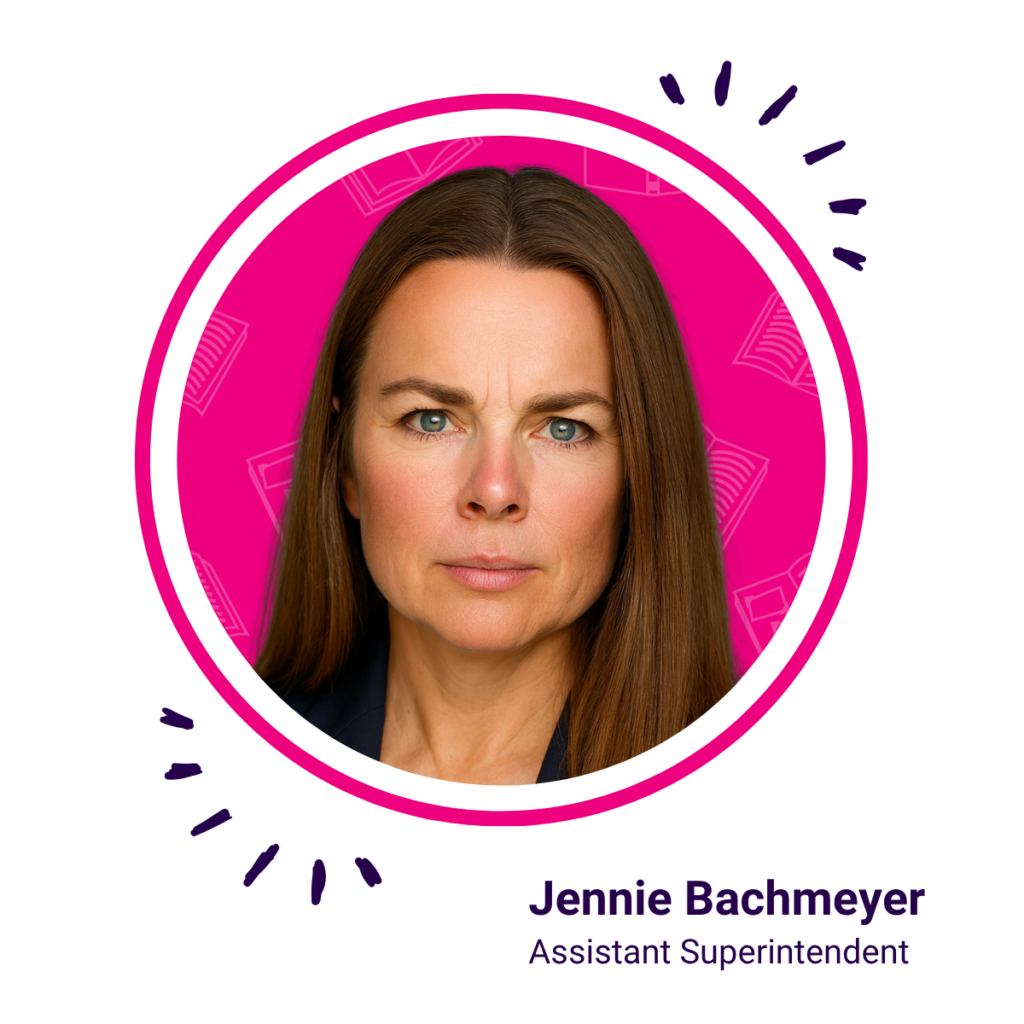
“You look at 1st grade, any curriculum that you get, it’s meant to be phonetic and phonics. You move to 2nd, all that goes away.”
— Jennie Bachmeyer, Assistant Superintendent, Red Bluff, CA
Phonics: vowel patterns and digraphs
Why 1st grade: These patterns cover the majority of words students encounter in connected text. Without them, reading slows to a crawl, and comprehension suffers.
Where to look: Decodable text assessments and any phonics scope-and-sequence checks built into your curriculum
Are students being assessed on pattern mastery, or just exposure?
Inflectional endings
Why 1st grade: These endings appear in almost every sentence of connected text. Students who haven’t automated them slow down on every page. This drag that compounds into measurably lower fluency and comprehension scores.
Where to look: Oral reading records and running records
Listen for students who pause or miscue on common endings even when they can decode the base word.
High-frequency words
Why 1st grade: A student who is still sounding out “said” or “were” in 2nd grade is burning cognitive resources that should be going toward comprehension.
Where to look: Sight word assessments at each benchmark window
Most programs have these built in. The question is whether the results are triggering intervention or just being logged.
Oral reading fluency
Why 1st grade: Fluency is the bridge between decoding and comprehension. A student who reads accurately but slowly cannot keep up with grade-level comprehension demands in 2nd grade, where text complexity increases sharply.
Where to look: ORF (Oral Reading Fluency) scores at each benchmark window
Targets:
- Approximately 21 words correct per minute by mid-year
- Approximately 39 by the end of the school year
Students below these thresholds are at high statistical risk of 3rd grade failure.
Writing conventions
Why 1st grade: Writing and reading are reciprocal. Encoding reinforces decoding in ways that reading practice alone doesn’t. Students who aren’t writing sentences are missing a reinforcement loop that accelerates overall literacy development.
Where to look: Writing samples and any curriculum-embedded writing assessments
What ELA data should be telling you (and when)
By the time end-of-year benchmark scores confirm a student is reading below grade level, the 1st grade window has closed.
The signal to watch is ORF throughout the year, not just at the end of it. A student reading below benchmark thresholds isn’t just a little behind. They’re at high statistical risk of 3rd grade failure without intervention.
Five questions to ask before next school year
If your end-of-year 1st grade ELA data didn’t reflect what you hoped for, these questions can help your team determine why and what to do next:
- What percentage of our 1st graders ended the year at benchmark? How much does that vary by school and classroom?
- How quickly does a teacher know when a student falls off the benchmark trajectory? Days? Weeks? Not until the next screener?
- What’s the Tier 2 pathway for a student identified below benchmark in October? Who delivers it, how often, and in what format?
- Is our Tier 2 capacity sufficient to reach every student who needs it, or are some students waiting while the window closes?
- Do we have outcome data for students who received Tier 2 support last year? Did they reach benchmark by the end of the year?
A strong 1st grade ELA program without a reliable Tier 2 pipeline isn’t a complete reading system. The curriculum does the heavy lifting. The intervention closes the gap for the students who need more than the classroom can give them.
The data at the end of this school year will tell the same story as last year’s, unless something in the system changes before it begins.