When Shraddha Nunziata started teaching middle school science in New York City in 2005, it didn’t take long to notice that the biggest obstacle in her classroom had nothing to do with science.
“My kids couldn’t read, my kids couldn’t access the science content,” Nunziata recalls. “It just felt like an injustice when I had 12-year-olds in my classroom who weren’t able to access text.”
“There’s something wrong,” she remembers thinking. “We’re doing something wrong. Why do so many kids come into middle school unable to read?”
In the two decades since Nunziata walked into that Bronx classroom, middle school reading in the U.S. has moved in the wrong direction, and that question has become one of the most urgent in American education.
On the 2024 National Assessment of Educational Progress (NAEP), known as the Nation’s Report Card, 33 percent of 8th graders read below the “basic” level. That’s the largest share in the history of the test, and the struggle starts well before middle school. NAEP data shows 69 percent of 4th graders read below proficiency, and 40 percent read below basic. The students struggling the most are losing the most ground: those at the 10th and 25th percentiles now read below the levels their peers reached three decades ago.
The problem behind those numbers has followed Nunziata through her career. Now, as senior director of special projects and initiatives for Savannah-Chatham County Public Schools in Georgia, she’s building an answer that districts across the country can learn from.
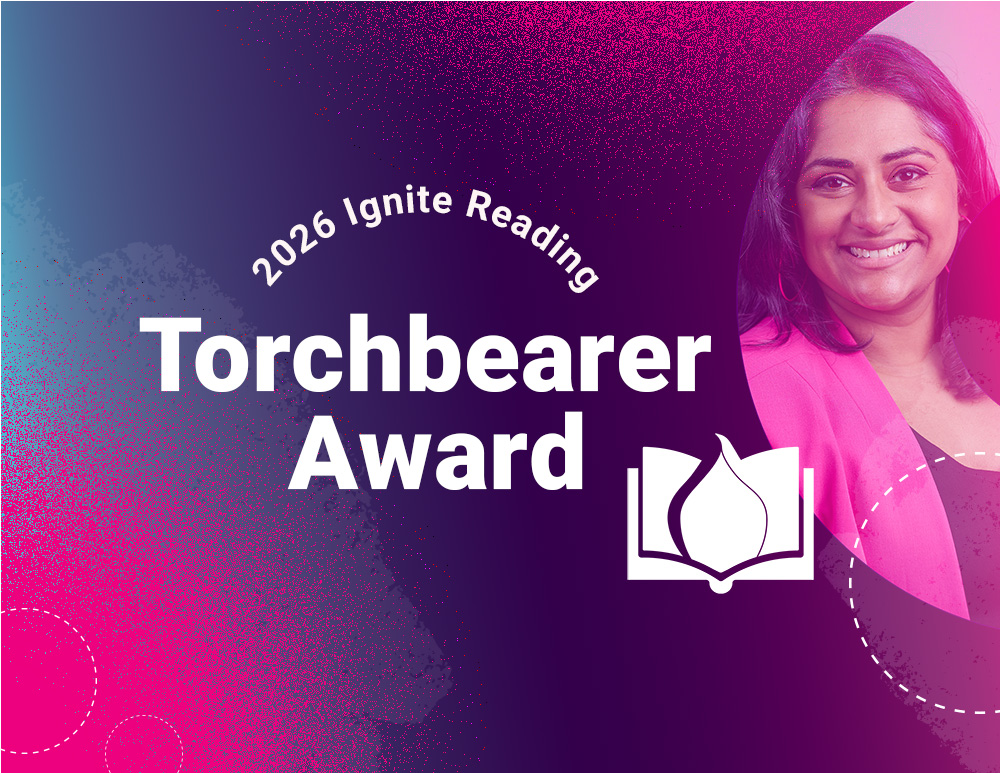
It starts in 1st grade, and it’s why Shraddha Nunziata has been named the 2026 Ignite Reading Torchbearer.

What is a Torchbearer?
The Torchbearer Award celebrates a district leader who doesn’t just understand research or implement programs, but who lights a fire in others and keeps it burning bright.
This recognition honors someone who has:
- Championed proactive intervention to ensure children read on benchmark by the end of 1st grade
- Created accessible pathways for diverse stakeholders to contribute to literacy efforts
- Measurably expanded access to early literacy resources for all students
- Built coalitions and amplified the work happening in classrooms
- Made the case for literacy equity in ways that move community members and policymakers to action
The Torchbearer: Shraddha Nunziata
Senior Director of Special Projects and Initiatives, Savannah-Chatham County Public Schools
From the Bronx back to Savannah
After her years in the Bronx, Nunziata built a career in education with a special focus on project-based learning and enrichment. That included six years leading high school enrichment across the Uncommon Schools network.
“That’s where I really got the systems-level perspective,” she says.
Eventually the Georgia city where she attended high school came calling. In 2024, Nunziata joined the district administration team at Savannah-Chatham County Public Schools, and she says Deputy Superintendent Staci Taylor gave her room to experiment from the start.
“Staci has given me a lot of trust and a lot of leeway to try stuff, take risks,” Nunziata says. “I’m very lucky because I have my dream job.”
Her favorite days are the ones spent with students, including the superintendent’s student senate, which she runs.
“Those are probably the best days,” she says, “because I get to hear directly from youth about what they’re passionate about, what they think we need to be doing differently and better.”
Her literacy why
For a former science teacher, a focus on reading might seem like a detour, but for Nunziata, literacy is the why behind it all.
“It’s the key to everything,” she says.
 Shraddha NunziataSenior director of special projects and initiatives, Savannah-Chatham County Public Schools
You can’t do science without literacy. You can’t do anything without it. It’s the foundation. People will fight and die for the right to read in other countries.
This isn’t hyperbole. Growing up, Nunziata saw children in India who would never get the chance to learn to read. Those memories and her classroom experiences were top of mind when she began working closely with Cherie Goldman, Savannah-Chatham’s literacy effectiveness officer, who introduced her to the Science of Reading.
“The light bulb went off, and that was the answer,” Nunziata recalls. “That was the solution.”
A promise that started with teachers
When Nunziata arrived in Savannah-Chatham, she found a district already moving toward a future where every child learns to read.
In April 2023, then Georgia Gov. Brian Kemp signed the Georgia Early Literacy Act, shifting reading instruction statewide toward the Science of Reading. Results from the Spring 2023 Georgia Milestones test in reading showed 43.5 percent of 3rd graders in Savannah-Chatham County were reading below grade level at that time. That summer, Superintendent Dr. Denise Watts took the helm of the district and named literacy the district’s north star.
Like many districts across the country, Savannah-Chatham had concentrated its intervention efforts on 3rd grade, when state testing begins, but when Nunziata sat down with teachers for empathy interviews, they urged her to start earlier, when gaps can be closed before they widen.
“It’s actually teachers that inspired the First Grade Promise,” she says. “The teachers are like, ‘Why are we pouring all our resources into 3rd? We’ve got to get them in 1st.’”
Listening first is central to how Nunziata leads.
“Before entering into any large-scale systems decision, you’ve got to listen to the people,” she says. “It’s going to affirm a lot of what you already know to be true, and then it’s going to challenge commonly held beliefs that will push us further.”
Turning what she heard into district policy still took persuasion.
“We’ve had to shift away from a mentality of intervening in 2nd and 3rd, in the testing years,” she explains. “Going to the earliest classrooms took some convincing.”
Savannah-Chatham Coordinator of Academic Intervention Services Ericka Coleman Washington credits Nunziata’s use of data to get stakeholders on board with systemwide changes.
“Shraddha’s work has shown me that data tells a story, and she has a unique ability to listen to what that story is telling us about our students’ needs,” Coleman Washington says. “Because of her work, literacy decisions are grounded in both evidence and a deep understanding of what students need to be successful.
“Other districts could learn from her ability to use data not as an endpoint, but as a starting point for meaningful action for struggling students,” she adds.
“You have to use data,” Nunziata says, “and you have to also appeal to hearts and minds.”
From a little bet to a districtwide promise
The data Nunziata brought to those conversations was hard to argue with. Between 2024 and 2025, the share of Savannah-Chatham’s 3rd through 5th graders reading proficiently slipped from 33 percent to 30 percent. The district was still outperforming similar districts, but Nunziata wasn’t willing to call that success.
“Outperforming similar districts was encouraging, but it was not the outcome we wanted to settle for,” she says. “Our kids reading below grade level deserve immediate support to build foundational literacy skills.”
Rather than overhaul everything at once, she proposed a test. In fall 2025, the district launched what Nunziata calls “a focused little bet,” a pilot of Ignite Reading’s high-dosage one-to-one tutoring for 100 readers in four schools. Students in the program grew about twice as much as their peers, giving Nunziata the data she needed to convince her colleagues, and the district school board, to shift its intervention investment to 1st grade.
This school year, every 1st grader in the district reading below the 50th percentile receives high-dosage tutoring in foundational reading skills, so they can close their skills gaps while the window of opportunity is still open.
Taylor describes Nunziata as mission-minded and tenacious, and she sees both qualities in how Nunziata built the case for 1st grade.
“Shraddha understands that regardless of the seat you occupy within an organization, your work must be anchored in its mission,” Taylor says. “And when I say mission, I am not referring to some lofty statement written in a book or displayed on a wall. I am talking about the fundamental purpose of public education: delivering the very best outcomes for students.”
Pointing to Nunziata’s work to make high-dosage tutoring part of how the district operates, she adds, “She helped transform what was once a possibility into a promise we are delivering on every day to improve literacy outcomes for students.”
Nunziata is quick to point out that tutoring is one piece of a larger system that also includes teacher training in the Science of Reading, adopting high-quality instructional materials, and implementing evidence-based universal screeners.
“It’s all these cogs that are working together and turning and making this literacy machine actually work for kids,” she says.
Her colleagues say what sets her apart is how easily she moves between that big-picture system and the smallest details.
“Whether convening a planning team, collaborating with school leaders on creating conditions for successful implementation, or helping a 1st grader adjust a headset and volume, she brings the same thoughtfulness and care,” says Savannah-Chatham County Chief Academic Officer Derrick Butler.
Going big: 95 in 5
The district’s boldest goal began taking shape at Convene 2025, where Nunziata and Goldman first heard about a literacy moonshot in Florida. In March 2026, Savannah-Chatham school leaders and the Chatham Education Alliance launched the Chatham Literacy Moonshot, which aims to raise the share of the district’s 3rd graders reading within or above grade level from 53 percent to 95 percent in five years.
Locally, they call it 95 in 5.
“That’s where it went from this idea of incremental change to a revolution,” Nunziata says. “We believe we can do this.”
Delivering the First Grade Promise in Savannah

Jessica Reid SliwerskiCofounder and CEO, Ignite ReadingGetting every single child to read on time isn’t rocket science, but it does take leaders willing to question how things have always been done.
Shraddha looked at a system built around 3rd grade testing and asked why we wait to intervene. Then she turned the First Grade Promise into a commitment her whole district keeps. She treats every 1st grader in Savannah-Chatham as if their future depends on this year, because it does.
That kind of urgency is what the Torchbearer Award exists to honor.
Nunziata is just getting started, and her colleagues say the way she leads is what will carry the work forward.
“In Shraddha, other districts and educators will find leadership that comes from her ability to bridge humanity, vision and execution,” Goldman says. “She does that work with both urgency and heart, and the children of Savannah-Chatham County are for the better because they have a champion in Shraddha Nunziata.”
Two decades ago, Nunziata was a science teacher in the Bronx with a classroom full of students who couldn’t read their textbooks. Today, in Savannah-Chatham, she’s helping to build the system she wishes those students had.
Nunziata knows the real test is still ahead.
“The ultimate measure of success will not be how many students participate in Ignite Reading,” she says. “It will be how many students receive the right support early enough that they no longer need intensive intervention later.
“Because literacy is freedom.”
Meet the superintendent behind Ignite Reading’s first Torchbearer award
When Almudena “Almi” Abeyta, Ed.D., looks around Chelsea Public Schools, she doesn’t just see students. She sees stories.