Work in education, or anywhere near it, and you’ll hear the words “Science of Reading” a few times a week. Some weeks, you’ll hear it a few times a day.
It’s hard to overstate its reach. More than 40 states have passed laws to bring reading instruction in line with cognitive research. Jessica Pasik, professional development director of the Reading League, has described the current literacy instruction landscape as “a unique moment in education history when Science of Reading has entered the zeitgeist.”
To borrow from Taylor Swift, education is decidedly in its Science of Reading era. And yet, more than a decade into the Science of Reading reshaping how America teaches kids to read, the term is still widely misunderstood. Some treat it as shorthand for phonics, a misconception Reading League founder and CEO Maria Murray has called difficult to shake. Others see it as a label stamped on a curriculum to improve sales.
It’s neither. The Science of Reading is a body of research, built over the past century, into how children’s brains learn to read and what instruction actually helps them get there.
Below, we trace where the phrase came from, starting with a letter to the editor in 1836, and walk through the landmark studies behind it, from Orton’s work on dyslexia to Scarborough’s Reading Rope. We’ll also look at what that research means for state policy today, including the states that have banned three-cueing.

What is the Science of Reading? A simple definition
The Science of Reading is an umbrella term that describes a wide-ranging body of scientific research into how kids’ brains learn to read and the challenges learners encounter along the way.
More than 50 years of converging evidence from developmental and educational psychologists, cognitive scientists and neuroscientists about what kids need to learn to read fluently.
A single program, curriculum or aspect of teaching reading. And despite a pervasive myth, it isn’t simply focused on phonics.
With so much research, there are enough findings to provide a clear understanding of which instructional methods are ineffective and what really works. This gives us a basis for building curricula and programs that truly align to what students need as they learn to read.
SOR doesn’t refer to any single aspect of teaching reading or any specific program or curriculum for reading instruction. And, despite a pervasive myth, it’s also not simply focused on phonics.
Where did the Science of Reading come from?
Does it feel like SOR took over the educational zeitgeist suddenly and almost out of nowhere? Google Search data backs up the feeling. The search engine shows Internet queries for the term began to take off in April 2022, and they’ve been on the rise ever since.

But the history of “Science of Reading” dates back much, much farther … nearly 200 years.
Well before neuroscientists could start scanning kids’ brains with MRI machines to understand what happened as they learned to read, at least one educator was calling on colleagues to turn to the science — or his version of it anyway.
One of the earliest pedagogical uses of “Science of Reading” has been traced back to at least the 1830s when it was first mentioned in the journal American Annals of Education and Instruction, for the Year 1836, Vol. 6. The phrase appeared in a letter to the editor decrying a lack of systematic spelling instruction in schools of the era.
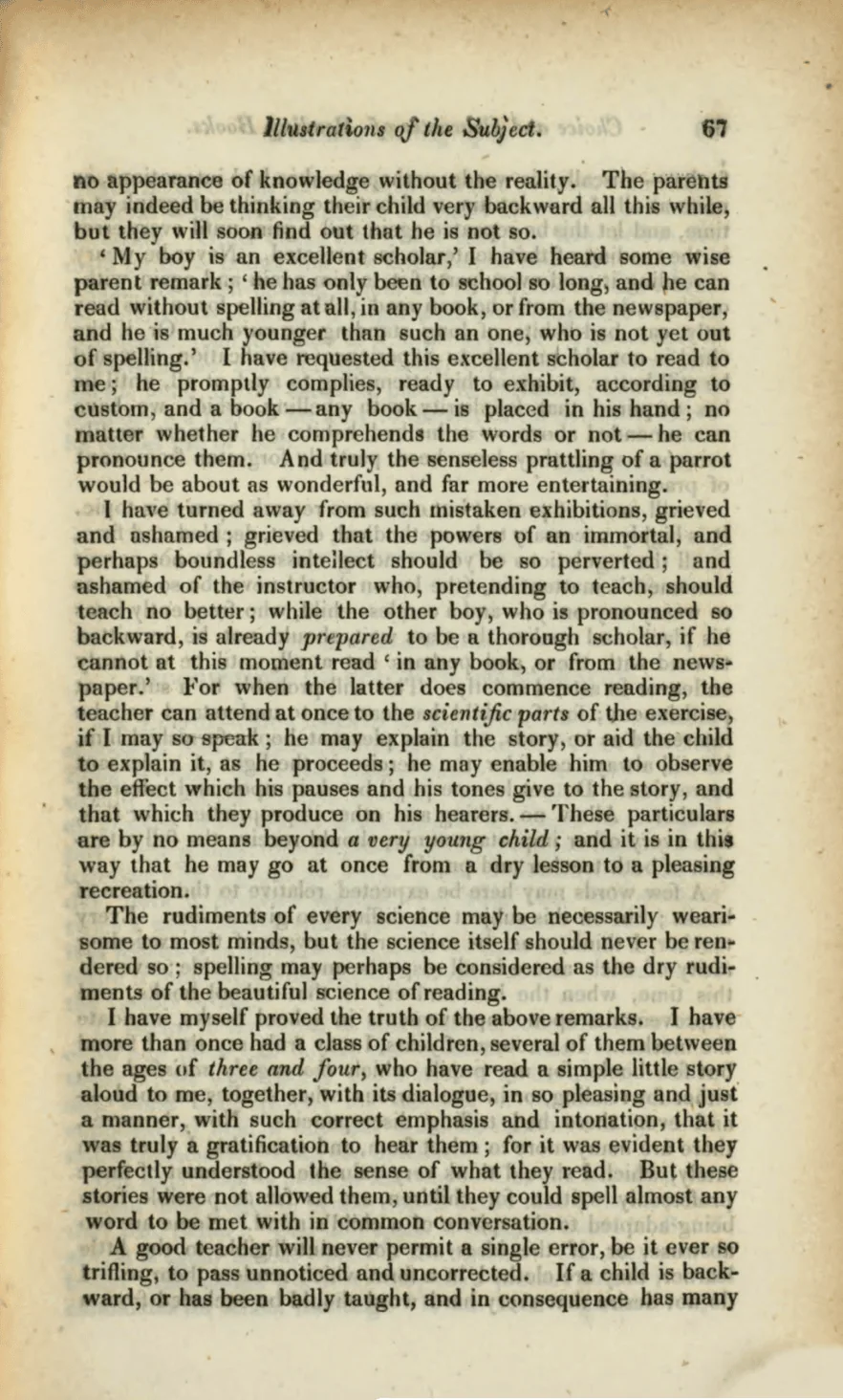
From a letter to the editor signed only “Experience,” in American Annals of Education and Instruction, for the Year 1836See the original page (opens in a new tab)“Spelling may perhaps be considered as the dry rudiments of the beautiful science of reading.”
Signed only “Experience,” the letter posits that students find reading to be a “difficult and disagreeable task” because adequate time is not spent teaching students to “master every variety of the word, from the most difficult of one syllable to those of many.”
“Spelling may perhaps be considered as the dry rudiments of the beautiful science of reading,” the letter writer notes, later advising, “It is highly necessary to be methodical, exact, decided and firm in all the regulations of your reading classes.”
The “Experience” letter offers little more than the author’s own opinions to support this version of the “Science of Reading,” but it bears at least passing resemblance to the actual findings of modern scientists that fall within the modern Science of Reading.
Just as “Experience” surmised back in the 1830s, scientific researchers have since proven that the majority of students require systematic, explicit instruction in letters and sounds in order to learn to read, and we now have the converging body of research we call “the Science of Reading” to back up the findings.
Key research studies in the Science of Reading
How did we go from the phrase “Science of Reading” appearing in a letter to the editor in 1836 to the vast majority of states adopting Science of Reading legislation or policies today?
That winding path can be tracked through a look at some of the important research exploring how humans learn to read and the most effective instructional methods that have been conducted in the past century.
Orton’s Theory of Dyslexia
Dr. Samuel T. Orton was one of the first U.S. researchers to identify dyslexia as a reading difficulty and to advocate phonics instruction for students who’d been diagnosed with dyslexia.
A neuropsychiatrist and pathologist who worked with adults with brain damage at the Iowa State Psychopathic Hospital, Orton set out to explain why children who had not suffered brain injury were displaying symptoms similar to those exhibited by the adults who had sustained language loss. He theorized that children who do not establish hemispheric dominance in particular areas of the brain display specific developmental language disabilities. He presented his theory of “word-blindness” at the 1925 annual meeting of the American Neurological Association in Washington, D.C..
Dr. Orton later joined forces with educator Anna Gillingham to create what’s still known today as the Orton-Gillingham method, an instructional approach that involves explicitly teaching the connections between letters and sounds to help students learn to read.
Orton wasn’t the first researcher to discover that dyslexia existed (that finding is credited to German neurologist Adolf Kussmaul, who coined the term “word blindness”), but he’s largely credited with laying the groundwork for both understanding specific reading disabilities and the need for tailored reading instruction.
Chall’s Stages of Reading Development
Jeanne Chall was a psychologist at the Harvard Graduate School of Education who received a grant from the Carnegie Corporation of New York to synthesize various studies of reading instruction that had been completed between 1910 to 1965.
In the resulting book published in 1967, Learning To Read: The Great Debate, Dr. Chall proposed that reading development occurs in six specific stages, which she broke down across approximate ages.
Each stage builds on the one before it. Ages are approximate, and readers move through the stages at their own pace.
- Stage 0Pre-readingBirth to age 6
- Stage 1Initial reading or decodingAges 6 to 7
- Stage 2Confirmation and fluencyAges 7 to 8
- Stage 3Reading for learning the newAges 8 to 14
- Stage 4Multiple viewpointsAges 15 to 18 (high school)
- Stage 5Construction and reconstructionAges 18 and up (college and beyond)
Source: Jeanne S. Chall, Stages of Reading Development (1983).
Chall also concluded that “code emphasis,” her name for what we call phonics today, was significantly more effective than the whole language method for teaching kids to read.
Advocating for a code-emphasis approach, Chall’s work established the importance of a systematic approach to reading instruction and the notion that early reading is significantly different from more mature reading.
The Simple View of Reading
In the late 1980s, cognitive scientists Philip B. Gough and William Tunmer posited that there are three types of reading disability:
- An inability to decode
- An inability to comprehend
- An inability to both decode and comprehend
In order to clarify the role of decoding in reading and reading disability, Gough and Tunmer proposed what they called a “Simple View of Reading.” Set up like a mathematical equation, the view illustrates that reading comprehension is the product of two primary components: decoding (D) and language comprehension (LC), where reading comprehension (RC) is expressed as RC = D x LC.
The Simple View of Reading helped establish the importance of both decoding and linguistic comprehension for reading comprehension. More than three decades since Gough and Tunmer first presented their theory, it’s still one of the most widely used in education.
The Matthew Effect in Reading
Around the same time that Gough and Tunmer were developing their Simple View, Canadian psychologist Dr. Keith Stanovich was publishing his theory on the reading proficiency gap that exists between students who learn to read quickly and easily vs. those who have difficulty reading at the start.
Dr. Stanovich described how early success in reading leads kids to read more, which in turn leads to greater skill development. At the same time, he noted that early difficulties in reading lead students to read less, which results in a widening gap in literacy skills over time.
The theory borrows from the Matthew Effect or Matthew Principle, a social phenomenon in which the rich get richer and the poor get poorer. The phenomenon got its name in the 1960s from sociologists Robert K. Merton and Harriet Zuckerman who drew inspiration from the Bible’s Gospel of Matthew.
The science shaping the Matthew Effect in reading has helped support the need for early intervention in reading.
National Reading Panel Report
In the late 1990s, then Director of the National Institute of Child Health and Human Development (NICHD) Duane Alexander and then Secretary of Education Richard Riley were called on by Congress to convene a panel of experts to analyze research into the various approaches to reading instruction. Fourteen individuals from around the country were chosen, including leading scientists in reading research, representatives from colleges of education, reading teachers, educational administrators, and parents.
That panel’s review of research from peer-reviewed journals covered more than 100,000 different studies.
The National Reading Panel Report, delivered to Congress in 2000, identified five pillars of effective reading instruction that are often referred to as the five components of the Science of Reading:
- Phonemic awareness
- Phonics
- Oral Reading Fluency
- Vocabulary
- Comprehension
The five pillars outlined in the report have given shape to reading instruction policies and practices throughout the U.S. education system. Studies completed in the years since the report was released have only strengthened the case for building literacy instruction around them.
Scarborough’s Reading Rope
Dr. Hollis Scarborough is a psychologist and literacy researcher who has contributed significantly to the Science of Reading, authoring and co-authoring more than 40 research papers that give us a window into the way students best learn to read.
Dr. Scarborough may be best known, however, for her creation of Scarborough’s Reading Rope, a visual representation that illustrates the key skills that must be mastered in order to become a proficient reader.

The Reading Rope consists of two intertwined strands: language comprehension and word recognition. These two strands encompass all of the skills needed to become a skilled reader with strong reading comprehension skills.
In Dr. Scarborough’s visual model, the strands are weaved together into a rope to show the connectedness of the skills and emphasize how proficient reading is dependent upon both strands being developed effectively.
Dr. Scarborough’s work complements the Simple View of Reading in illustrating how interconnected early reading skills are. Adding in sub-skills, the rope goes one step further to help educators understand how those sub-skills combine to support learning to read.
Science of Reading legislation and state policies today
These studies, and countless like them, have helped shape not just educators’ understanding of what students need to become fluent, confident readers but politicians’ too.
Since 2013, the majority of states across the country have either passed laws or enacted policies to support Science of Reading-aligned instruction in schools.
A number of those states have specifically come out to ban or significantly restrict three-cueing, a common literacy instruction strategy that’s been wholly debunked by scientists.
- Alabama
- Arkansas
- Florida
- Indiana
- Kansas
- Louisiana
- Minnesota
- North Carolina
- Ohio
- Pennsylvania
- South Carolina
- Texas
- Utah
- Virginia
- West Virginia
- Wisconsin
- Massachusetts: Signed 2026; takes effect fall 2027
- Michigan: Signed 2024; takes effect in the 2027–28 school year
- Oklahoma: Signed 2024; takes effect in the 2027–28 school year
- Kentucky: Signed 2026; full phase-out by the 2029–30 school year
- Georgia: 2025; can’t be the primary method of reading instruction
- Missouri: 2025; can’t be the primary method of reading instruction
As of November 2026. Laws change often, so check your state’s education department for the latest requirements.



Content updated: