A spark can be easy to miss. It doesn’t light up the sky like a bonfire or warm up a room like a roaring fireplace. A spark is quiet and quick.
It’s a literacy director placing a book in front of a parent as an invitation to grow. It’s the moment the reading code clicks for a child, and she begins to see herself as a reader.
A spark is how things begin.
In two cities, thousands of miles apart, three educators have sparked a belief that’s slowly growing into a flame: A belief that every child in their school districts can learn to read on time.
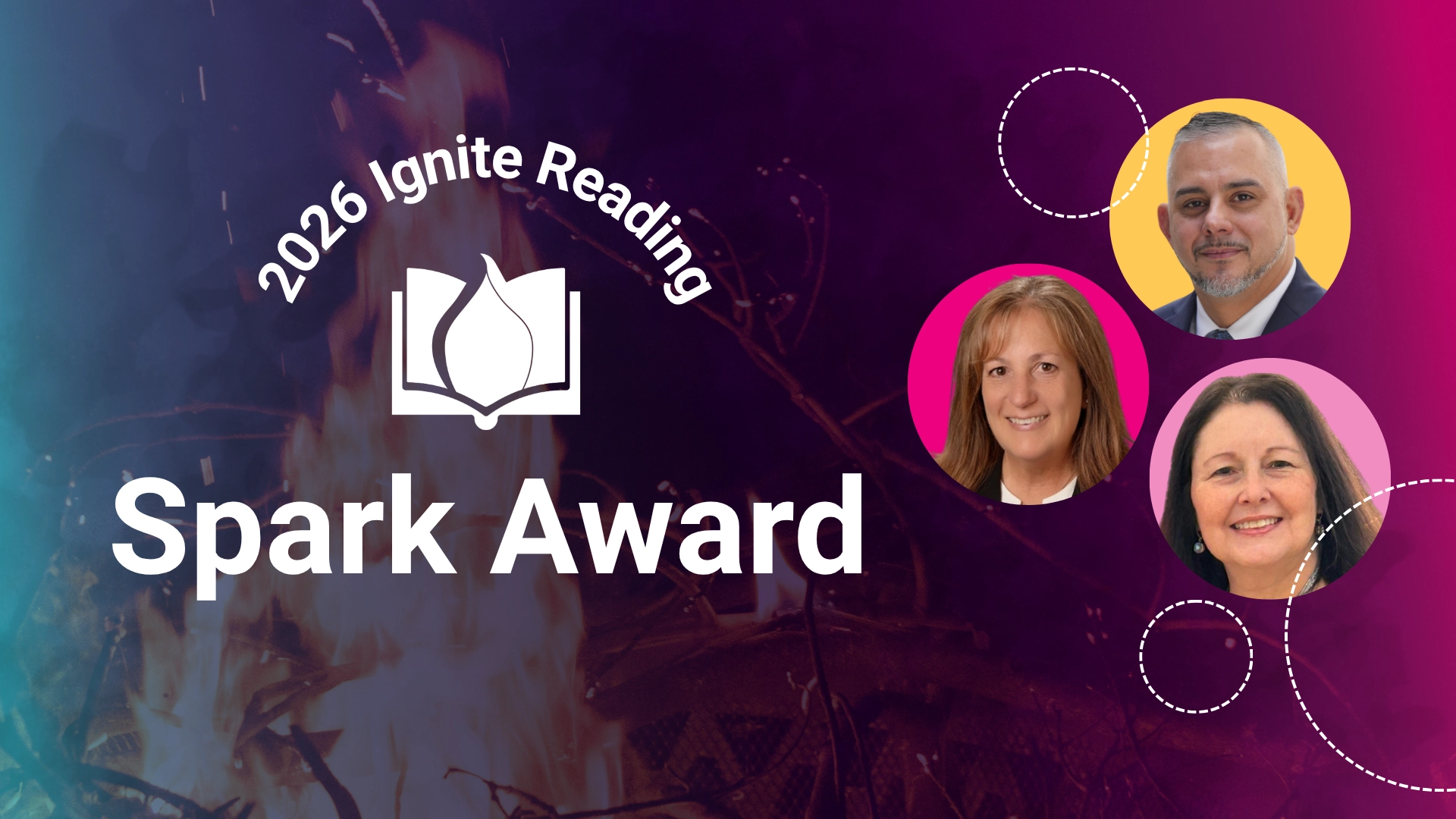
This belief is why Michelle Graham of San Bruno Park School District, and Laura Mendes and Jose Escribano, Ed.D. of Springfield Public Schools are the recipients of the 2026 Ignite Reading Spark Award.
Their journeys to district leadership and the roles they hold today are as diverse as the communities they serve, but all three share the refusal to sit back and wait while children in their districts fall further behind.

The Ignite Reading Spark Award recognizes educators who have sparked meaningful change in early literacy in their districts through innovation, advocacy, and tireless dedication.
Recipients demonstrate:
- Deep expertise in the science of reading and literacy instruction
- An ability to build and sustain systems that support teacher growth
- Commitment to data-driven decision making
- Success in creating conditions for all students to become strong readers
- Leadership that inspires and empowers others in the literacy work
Michelle Graham
Director of Teaching, Learning and Intervention, San Bruno Park School District, CA
When Michelle Graham starts talking about the moment a child’s reading skills start to take off, something happens.
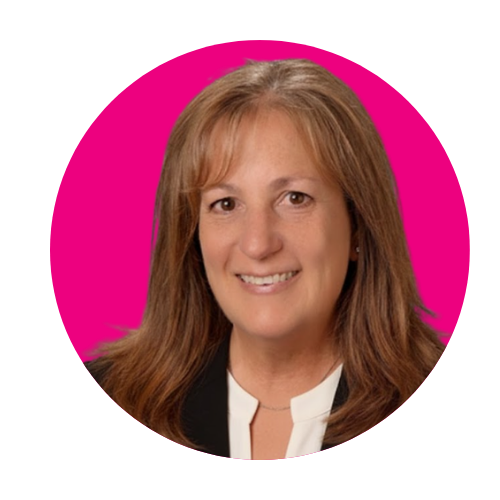 Michelle GrahamDirector of teaching, learning, and intervention, San Bruno Park School District
It’s magical. That sparkle in their eyes comes back, that smile comes back, the engagement starts to come back.
The description is one that’s easy to recognize. That same sparkle takes over Graham’s own eyes and smile the moment she’s engaged in a conversation about early literacy.
“I think that’s why we’re all in education, right?” she asks. “For that magic?”
Raised in a family of educators, Graham grew up listening to dinner table stories about how hard it can be to reach students where they are and how much parents and guardians shape a child’s success.
That passion carried her from the classroom to roles as a language specialist, director of student services, assistant principal, and principal. Today, she spends much of her week knee-deep in the work of program design, building out programs and processes in support of the district’s goal of getting 80% of its students reading by 3rd grade.
San Bruno Park Superintendent Matthew Duffy, Ed.D. calls Graham an “implementation master.”
“She is one of those rare leaders who can bring vision fully into practice,” he explains.
San Bruno Park serves about 2,000 students from preschool through 8th grade in a city between San Francisco and Silicon Valley. More than half of its students are classified as socioeconomically disadvantaged, and a quarter are multilingual learners.
An upside-down picture
When Graham looked at which students needed reading support, the picture was upside down. In a healthy system, most students thrive with core instruction and only a small group needs intensive help. San Bruno Park had the opposite.
So she wrote a three-year districtwide intervention plan, now in its second year. It rethinks Tier 1 and Tier 2 support, pairs in-person intervention teachers with high-impact tutoring, and wraps support around students and their families. It’s the decision she’s proudest of, and it wasn’t an easy one.
“The most difficult part of this work is reframing the mindset of administration, staff and families, and funding support,” she says.
In turn, her district colleagues say Graham’s commitment to kids ignites them all.
A leader who shares what she learns
When San Bruno Park Assistant Superintendent Anjelica Zermeño heard Graham had been nominated, she said it was exciting, “but honestly, not at all surprising.” Zermeño says Graham’s “hard work, innovation, and heart” were well deserving of the honor.
“[Her] leadership, kindness and mentorship have made such a positive impact on all of us in the office,” another San Bruno Park colleague (who asked not to be named) adds.
Katharine Sullivan is executive director of The Big Lift, the San Mateo County early literacy initiative that partners with eight school districts, including San Bruno Park. She has watched Graham share what she’s learned across all of them.
“She actively participates in shared learning collaboratives, generously sharing lessons learned, tools, and resources to support the success of others,” Sullivan says. “Michelle truly embodies the spirit of collective impact, the belief that no single person, school, or agency can close educational opportunity gaps alone.”
But it’s the words of a 2nd grader that truly show the spark growing in San Bruno Park.
Miranda* had struggled academically since arriving in the district in transitional kindergarten. In February of 2nd grade, she began getting one-to-one help every school day with the foundational reading skills she was missing, and one day in May she stopped Graham to share some news.
“Guess what, Ms. Graham! I can read now!”
Jose Escribano, Ed.D.
Assistant Superintendent of Community Engagement, Family Empowerment and Partnership, Springfield Public Schools, MA
When Jose Escribano, Ed.D. looks back on his early days as a reader, he sees the kind of kid that he’s built his career around helping.
“This was probably before there was such a thing as an IEP,” the assistant superintendent for Springfield, Massachusetts’ public school system recalls. “But I was always in the small group.”
Decades later, Escribano lived it from the other side: His son was struggling as a reader, and for a long time, the family was told nothing was wrong. They kept pushing until he was finally tested and got the help he needed.
“Because he had parents that could advocate for him, he was able to learn how to read and graduate,” Escribano says. “But I just think about all the other students that didn’t have that advocacy.”
He knows how easily a reading difficulty gets mistaken for something else.
“When we don’t teach kids how to read, or we don’t address their learning disabilities, it almost becomes like an intelligence issue,” he says. “The appearance might be that they’re not intelligent, but they are very intelligent.”
Escribano didn’t start his career in a school. He spent nine years as a state social worker, half of them in adoption services, and kept running into the same patterns in the families he served.
“The only thing that I knew that could break the cycles of poverty was education,” he says.
A promise to every parent
He joined Springfield Public Schools in 2009 as a counselor and later moved into school leadership. As principal of a turnaround school that ranked in the 2nd percentile statewide, he made a promise to every parent who walked in worried about whether their child would qualify for special education.
“It doesn’t matter to me if you’re a special ed student or if you’re not,” he says. “If you need an intervention, you’re going to get an intervention.”
His school began phonics-based instruction before the district made the shift, and kept it going even through the pandemic. By his fifth year, the school had moved out of priority status.
An investment that can’t wait
Springfield is the third-largest city in Massachusetts, and about a quarter of its residents live below the poverty line. Students move in and out of the district’s schools throughout the year, and many arrive without preschool or kindergarten behind them. Today, Escribano pushes the district to treat early literacy as an investment that can’t wait.
 Jose Escribano, Ed.D.Assistant superintendent of community engagement, family empowerment and partnership, Springfield Public Schools
We need to financially invest in literacy. We can’t be satisfied to say, well, we got 60% of our kids reading on grade level, or 70. That’s not enough.
Colleagues say the same care shows up in every conversation. Lorilee Cabrera-Donovan, a district elementary ELA instructional leadership specialist, says she’s heard one phrase about him over and over, from his staff when he was a principal and from colleagues today: “Él está aquí para los estudiantes y sus familias.” He is here for students and their families.
“That has been my exact experience whenever I have approached him with a question or concern regarding a school or a particular student,” Cabrera-Donovan says.
Springfield’s Literacy Supervisor Kate Asher has watched that commitment carry from his years as a principal into his district role.
“Building on Dr. Escribano’s legacy as a compassionate former principal, he has always been deeply committed to empowering educators with the exact resources needed to ensure every child masters the gift of reading,” Asher says.
Escribano’s advice for other district leaders starts with the science.
“We have to follow the research,” he says. “What does the research say about literacy and about acquiring these skills? I think that’s the first component.”
When schools get reading right, he says, families notice. He’s seen parents’ trust in their schools grow as their children begin to read.
“They become more confident in the school, they begin to trust the school,” he says. “‘I trust you because you’re teaching my kid how to read. You’re doing the thing that you said you were going to do.’”
Laura Mendes
Director of Literacy, Springfield Public Schools, MA
The work that first sparked Laura Mendes’ commitment to help kids learn to read didn’t come with a paycheck.
Mendes was a young parent in the late 1980s when she first saw an opportunity to get involved in the Springfield Public Schools classrooms as a volunteer. She began showing up to read aloud to students and organize parent groups, and that volunteer gig slowly made way for a career in education.
In the early 1990s, Mendes took a job as a paraeducator. She earned her teaching license in 2001, became a literacy coach, and eventually moved into district leadership. Today she serves as director of literacy in Springfield, and she hasn’t forgotten who helped her get there.
“I was nurtured and encouraged by colleagues and leaders as I juggled home life, work, and continuing my education,” Mendes recalls.
 Laura MendesDirector of literacy, Springfield Public Schools
One of my goals is to pay it forward and treat new educators and colleagues as I was treated, with lots of love and encouragement.
That history shows in how Mendes shows up not just for other educators but for the district’s students, says colleague Cabrera-Donovan.
“She can confidently speak in a room full of our field’s brightest minds as well as bend down to speak eye-to-eye with our youngest learners with the same passion and dedication,” Cabrera-Donovan adds. “She understands the important role we all play, whether we are considered an expert in the field or we are the ones sending our babies and our dreams into our schools’ classrooms. She knows we are all here trying to ensure that all of our children learn to read and become literate members in our community.”
Mendes spends her time in Springfield on the move, and no two weeks look the same. Some days she’s knee-deep in the data, the next she’s in meetings with educators and building leaders, and days later she’s back in the classrooms where she got her start.
“I get fuel from the successes, and lessons from the rest,” Mendes says.
Changing hearts and minds with data
For years, Springfield taught reading the way many Massachusetts districts did, with whole language and balanced literacy. Mendes helped lead the district away from it.
“We were a district historically steeped in whole language and balanced literacy practices, with only a small subset of students meeting with reading success,” she says. “Changing hearts and minds took work. Starting with, and continuing with, data was key.”
She built the case one small implementation at a time. When Escribano was a principal, he recalls asking Mendes if more of his students could take part in early phonics work at his school. Her answer was simple: Involve as many kids as you can.
She took a similar approach when it came to implementing high-dosage tutoring in foundational reading skills for kids in the district. After a local philanthropic organization encouraged district leaders to visit a neighboring district, Springfield piloted Ignite Reading’s virtual early literacy intervention program in four schools. The results were convincing. Last school year, the district used state funding to bring tutoring to all of its 30-plus elementary schools. This year, roughly 1,700 students will get that support, thanks in no small part to Mendes.
Sharonda Hector, principal of DeBerry Elementary School, saw Mendes’ advocacy up close when she helped DeBerry secure more tutoring seats for students who needed them.
“Rather than allowing limited resources to determine which children received help, Laura listened to our concerns, recognized the need, and took action to find a solution,” Hector says. “She sees the need, advocates for children, and finds a way to remove barriers so more students have the opportunity to succeed.”
Colleagues say Mendes spends a lot of late nights keeping the spark growing in Springfield, driven by a belief that every child deserves the opportunity to learn to read on time.
“Laura works tirelessly behind the scenes as a fierce advocate for every striving reader,” says Literacy Supervisor Kate Asher. “Her dedication isn’t just about reading scores; it’s a relentless belief that literacy is every child’s fundamental right.”
Finding her people
Mendes is quick to say she doesn’t do the work alone. Every Springfield school has at least one literacy coach, known as an ELA instructional leadership specialist, and she calls them her heroes.
Her advice for district leaders starting this work comes straight from them.
“Find your people! Embrace your people! And let your people find you!” she says. “I think of the [instructional leadership specialists] I get to work alongside. They are my heroes and sheroes! They are my people!”
A promise kept one 1st grader at a time
These three Spark Awards were presented November 5, 2026 by Jessica Reid Sliwerski, cofounder and CEO of Ignite Reading.

Jessica Reid SliwerskiCofounder and CEO, Ignite ReadingA single spark won’t change a school district on its own, and Michelle, Laura and Jose understand that.
They’ve taken on some of the hardest work in education, igniting an entire system around early literacy, and they’re doing it bravely and unapologetically.
That’s what it takes for the First Grade Promise to deliver the reading outcomes every child deserves.