
For most of my career, I have understood the importance of students reading proficiently by 3rd grade. Like many educators, policymakers, and community leaders, I know the research showing that students who are not reading well by the end of 3rd grade are far more likely to struggle academically later on, less likely to graduate from high school, and more likely to encounter long-term barriers that extend far beyond school itself.
As a 1st grade teacher, a state education chief, and a superintendent, I never questioned the importance of the years leading up to 3rd grade. Children do not suddenly become readers in 3rd grade. Reading development begins much earlier.
What I hadn’t fully appreciated was how powerfully our systems organize themselves around what is most visible.
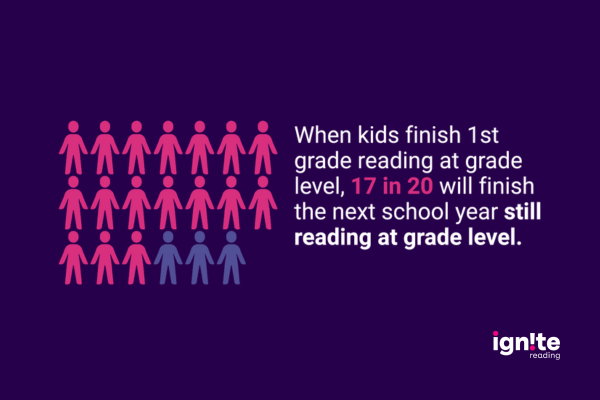
A recent Johns Hopkins University evaluation of early intervention followed nearly 1,600 1st graders across 13 Massachusetts districts. The findings are striking. When students finished 1st grade reading at grade level, 17 in 20 stayed on track the following year without additional intervention. But when students finished 1st grade behind, just 1 in 8 caught up on their own.
Over the years, I sat through countless discussions about 3rd grade reading results. We looked at state assessment data, accountability measures, intervention plans, and achievement gaps. Those efforts helped improve reading outcomes for students, and like educators across the country, we devoted enormous energy to helping more students reach that benchmark.
But at some point, I found myself asking a different question: If we know that reading trajectories are formed much earlier, why are so many of our policies, reporting systems, accountability structures, and intervention efforts still organized around what happens in 3rd grade?
I saw one answer to that question recently in Chelsea Public Schools.
Nearly every student in the urban Massachusetts district qualifies for free or reduced-price lunch, and many are multilingual learners.
Like districts across the country, Chelsea cares deeply about 3rd grade reading outcomes. But under Superintendent Almi Abeyta’s leadership, the district has organized its literacy strategy around 1st grade.
That may sound like a subtle distinction, but it changes a great deal. It influences resource allocation, staffing decisions, scheduling priorities, intervention structures, and where urgency is focused. Rather than waiting for students to approach a 3rd grade benchmark before mobilizing support, the district has built its system around changing reading trajectories much earlier.
Building the road to “read by 3rd”
Since the mid- to late-1990s, literacy policy conversations in the U.S. have focused on ensuring students reached proficiency by 3rd grade. States created reading guarantees, accountability systems, intervention requirements, and reporting structures, all intended to improve outcomes by that milestone.
Third grade became a powerful organizing point for policymakers and educators because it provided a clear, measurable indicator of whether students were developing the reading skills they would need for future success. The goal was not just to improve a test score but to improve life outcomes for children.
Third grade also became the defining milestone for a more practical reason: it is where public accountability first becomes visible. State assessments begin in 3rd grade, which made it the year communities, policymakers, and school systems could most clearly see whether students were on track. Over time, that visibility shaped how systems organized their attention, resources, interventions, and urgency.
Yet more than two decades later, too many students are still struggling to become proficient readers. Continuing to improve reading instruction remains essential. But the persistence of these challenges should also prompt us to ask another question: If we know that reading development begins long before 3rd grade, are we focusing enough attention on the years when reading trajectories are actually being formed?
Roots of read by 3rd
The 3rd grade finish line has its roots in the work of literacy researcher Jeanne Chall and the 6 stages of reading development she identified while studying how children learn how to read. Chall’s work helped popularize the idea that students shift from “learning to read” to “reading to learn” around 4th grade.

What the research says
Increasingly, the research supports that shift in thinking.
The Johns Hopkins University evaluation of early intervention delivered by Ignite Reading followed 1st graders across 13 Massachusetts districts. The findings offer powerful evidence of just how consequential 1st grade can be.
To put a finer point on this:
- 85 percent of students who ended 1st grade on benchmark also ended 2nd grade still reading on benchmark.
- Meanwhile, just 12 percent of the students who’d finished 1st grade behind were able to catch up during their 2nd grade year.
These are striking statistics, not simply because of what they say about literacy development, but because of what they say about timing. By the time many students are visibly struggling in 2nd or 3rd grade, the challenge is often no longer emerging. It has already become deeply established.
The issue is whether our policies, intervention systems, staffing structures, transparency measures, and sense of urgency are aligned with what we already know about how reading development actually happens. Too often, they are not.
When I look at these findings, I don’t see a reason to become discouraged. Instead, I see confirmation of something many educators have known for years: if we want different 3rd grade outcomes, we have to pay even closer attention to what is happening in 1st grade.
To me, these findings are not an argument for abandoning the policies and practices we have around 3rd grade reading. They are an argument for strengthening those efforts. They remind us that if we want more students reading proficiently by 3rd grade, we have to build systems that identify challenges sooner, intervene sooner, and support students before gaps have years to widen.

The long-term story
The data behind the 3rd grade benchmark is also the strongest case for not waiting until 3rd grade. The Annie E. Casey Foundation’s “Double Jeopardy” study found that students who aren’t reading proficiently by the end of 3rd grade are four times more likely to leave high school without a diploma. The 2012 study also revealed that risk multiplies for students who also experience poverty.
Where we go from here
More recently, the growing focus on the Science of Reading has also strengthened core literacy instruction and better equipped teachers with research-based tools and practices for teaching children to read. These policies and practices have helped create needed urgency around early literacy, and in many ways they have moved the field forward.
Districts across the country have worked incredibly hard over the past several years to strengthen literacy instruction. Teachers have embraced the science of reading, adopted stronger instructional materials, and invested deeply in professional learning. That work matters enormously, and I continue to believe it is foundational.
What I have come to appreciate, though, is that this is not an either/or conversation. Even with strong classroom instruction in place, there will still be students who need more intensive support. We also need policies and systems that begin early enough and intensively enough to change trajectories before reading difficulties become deeply entrenched.
This is what makes the work in Chelsea Public Schools so compelling. Under Superintendent Almi Abeyta’s leadership, the district has made 1st grade a central focus of its literacy strategy, building staffing, interventions, and support systems around the years when reading trajectories are being formed.
Chelsea is not abandoning the goal of 3rd grade reading proficiency. It is demonstrating what it looks like to organize a system around the belief that the surest path to reading by 3rd grade begins much earlier.
If I were leading a district or state today, I would still care deeply about 3rd grade reading outcomes. But I would make sure our systems, policies, investments, interventions, and accountability structures reflected the urgency of what needs to happen for our 1st graders. I would want those systems to push my team and me to address harder questions:
- Are we identifying reading challenges early enough?
- Are students receiving truly intensive support before frustration takes root?
- Are we allocating our strongest resources where they can change long-term trajectories most effectively?
- Are our policies and intervention systems aligned with the developmental reality of how children learn to read?
I think many of us are arriving at the same realization: we have long understood the importance of reading proficiency by 3rd grade. The challenge now is ensuring that our systems reflect the urgency of what must happen before students ever get there.
If we truly believe reading changes the trajectory of a child’s life, then the promise we make to 1st graders may be one of the most important promises our education systems can keep.